
Incoming Convener, Laura Stewart, with outgoing Convener, Karly Kehoe, at the 2025 Jenny Wormald lecture.
Trustees and editors extend their warmest thanks to Professor Karly Kehoe, who stood down in October 2025 not only as Convener, but also as one of our longest serving members. A changing of the guard has given the Trust an opportunity to reflect on the advances we have made – and the work we still need to undertake – in promoting greater equality, diversity, and inclusion.
Karly took over the role during the Covid-19 pandemic. Under Karly’s leadership, the Trust actively looked for ways in which it could offer practical support to members of our academic community. We were especially concerned about early career scholars, battling to complete doctoral and postdoctoral projects in very difficult circumstances, and those trying to maintain research as independent scholars without the benefits of institutional support. To this end, we made the decision to target our bursary provision at these groups. In 2024, the Trust launched an Early Career Essay Prize to stimulate submissions to the journal from, and recognise the work of, promising and imaginative younger scholars. In 2025, the Trust concluded that we should go further to support authors who exhibit specific protected characteristics. With the necessary legal work now completed, we are ready to relaunch the Prize in May 2026.
The intensification of social inequalities evident during the pandemic and the subsequent years of economic challenge acted as a spur to the Convener, the editors, and the Trustees to reassess our larger mission. What example was the Trust offering to the wider academic community? Was there more we could do to become a reliable source of information about, as well as offer leadership in, best practice? Having first looked to the Trust’s own constitution and policies, which were comprehensively updated in order to put equality, diversity and inclusion at the heart of what we do, we turned to the journal itself.
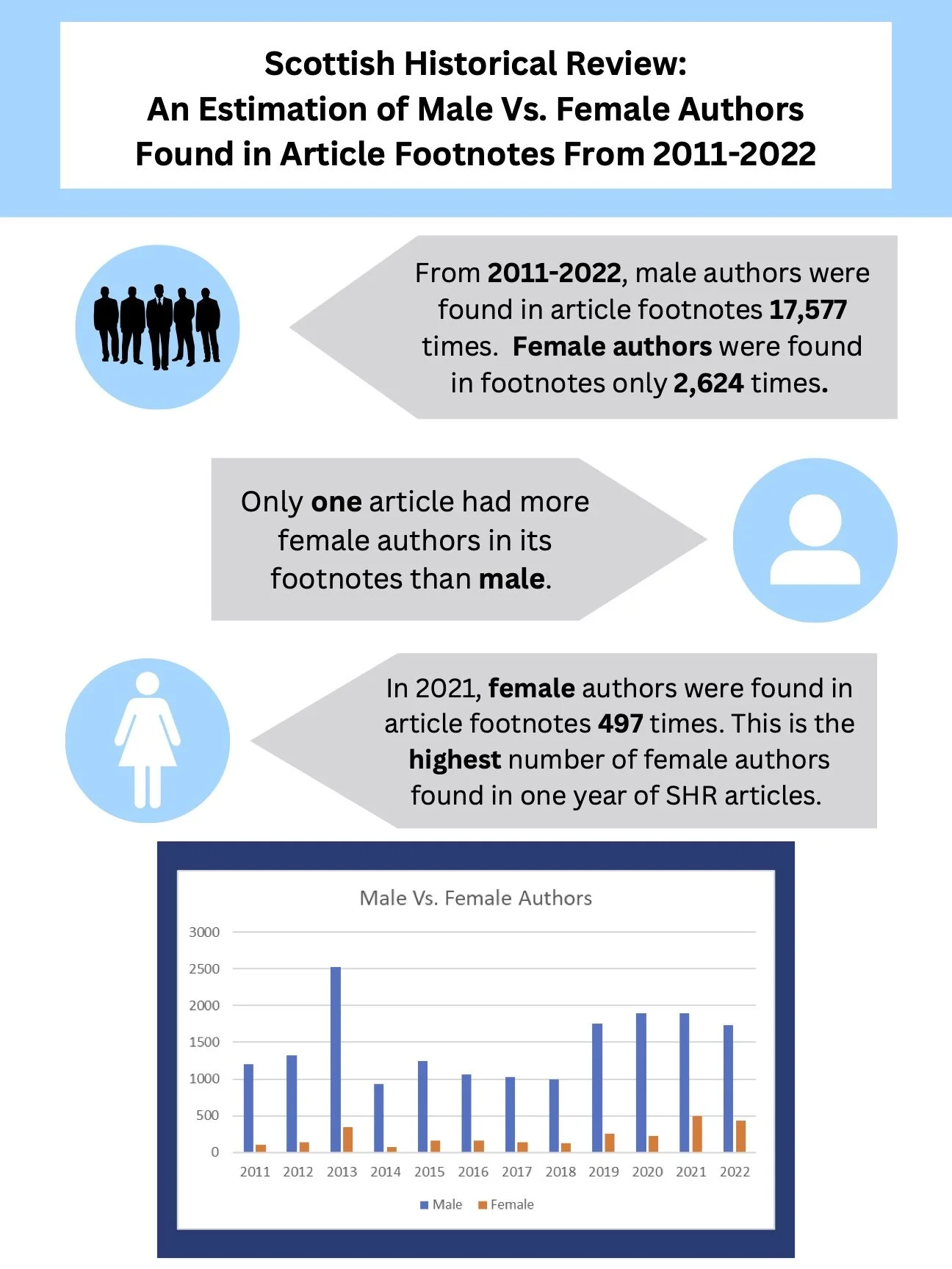
Trustees were very conscious that the publication record of the SHR, like many academic journals, was heavily dominated by male authors. Data compiled by Katie Barclay and Rebecca Mason for a special issue of the SHR in 2023 showed that, although a rising proportion of articles were being authored by women over the past couple of decades, at 35 percent, there remains some distance to travel to achieve gender parity. An important piece of research conducted under Karly’s auspices revealed not only that there are fewer articles in the SHR written by women, but also that the work of women is being under-cited by a ratio of almost 7:1. How could we make the SHR an attractive place to publish for women and for scholars from backgrounds more representative of society at large?
One opportunity was to make our special issues into showcases for new research agendas and archival techniques in which marginalised, silenced, and subordinated social groups can become more visible to us. Another was to promote the work of scholars from social groups typically under-represented in the journal through open access content and social media. The Trust particularly wanted to do something that would shine a light specifically on the achievements of female scholars. Working closely with then Treasurer, Dr Esther Mijers, and Secretary, Dr Sally Tuckett, and collaborating with sister-organisations, the Scottish Medievalists, the Scottish Catholic Historical Association, and the Scottish History Society, Karly oversaw the establishment of the annual Jenny Wormald lecture in 2023. Named in honour of one of the discipline’s leading scholars, and expressly designed to celebrate the work of female scholars, the lecture is also published in the SHR.
Perhaps the most important work we have done in recent years was an ‘end-to-end’ reassessment of how an article travels from submission to publication. We believe that the most rigorous academic standards are not at odds with, but are dependent on, constructive and transparent processes. Thus, we have overhauled our whole procedure, from the pre-submission guidance for authors, to the practices we require of our peer reviewers, to how editors frame feedback, to the additional support Trustees can offer to early career authors and those who disclose disabilities.
In the past half-decade, the Trust has become a more forceful and committed advocate both for the discipline and for the ideals we wish to see placed at its heart. Scottish history and its cognate fields, like the rest of the arts and humanities, are under intense scrutiny, as financial and economic pressures raise difficult questions about how we ascribe ‘value’ to scholarship and knowledge. The work we do at the SHRT allows us to see something of the intellectual vibrancy of the field and, encouragingly, there is certainly no shortage of it on display amongst the younger generations on whom the future depends. As incoming Convener, Laura Stewart is as determined as her predecessor to ensure the SHRT continues to do everything it can to help sustain that vibrancy and protect the future of our discipline.
Karly and Laura give their thanks to Conveners, officeholders, editors, and Trustees, past and present, and to the fantastic teams at Edinburgh University Press, who share our mission. It is this collective effort that has made the Trust what it is today.
Image above: Courtesy of S. Karly Kehoe.